


Table of Contents
“Ask 10 people what makes your organisation special, and you will get 11 answers.” We say this on our homepage, because we frequently observe this in client projects. In September 2026, it turned up as data.
On 2 September we ran Credible by Design, a live workshop where people draw a maturity map of their own organisation: what’s working in terms of their website and culture, and what needs attention first. Over 20 people took part. Several did not come alone. One organisation sent 3 people, others sent 2.
When we reviewed the workshop the next day, we noticed something: colleagues named collaboration as a strength, and yet they drew different maps. This article is about that gap: why it exists, why it’s often invisible from the inside – and what it tells us about organisational alignment.
Strong vibes, wobbly understanding
We ran a poll with 2 questions during the session:
- Where is your organisation strongest?
- What area needs treatment first?
Half of the respondents named collaboration as a top strength.
The second question pointed the other way: about 7 in 10 people said they needed to improve the clarity of their offer, and 6 in 10 stated that they need to set up a Voice of the Public programme to better understand the people they serve. Only about 1 in 4 named making their website the single source of truth.
Read together, the two polls describe organisations that feel good about their atmosphere – and unsure about whether they and the people they serve understand each other.
Participants placed their strengths on the inside of the organisation and their problems on the outside. But that’s not quite the full story.
Same organisation, different maps
When we looked at how colleagues from the same organisation had answered, they did not agree. People who work together every day, in some cases a leader and their own team, chose different strengths and different priorities.
Now, these poll results are anecdotal, and some of it may be noise. Both polls let people pick several of 9 areas, and 2 people choosing 2 or 3 items each will differ by chance. (We’re treating this as an observation to test on the next runs.)
But they’re curiously aligned with the results of a 2023 study by cognitive scientists at the University of California, Berkeley. As the headline puts it: People Differ Widely in Their Understanding of Even a Simple Concept Such as the Word ‘Penguin’. That’s because when we hear the word “penguin”, or “collaboration”, we don’t think of the dictionary definitions of these terms. Instead, as the article puts it, “people think of concepts: the myriad properties, ideas, examples and associations that spring to mind when we think about a word.” And these concepts “vary from person to person on a shockingly frequent basis”.
If people already hold vastly different concepts of something as concrete as a penguin, imagine the discrepancies that come up for an abstract term such as “collaboration”.
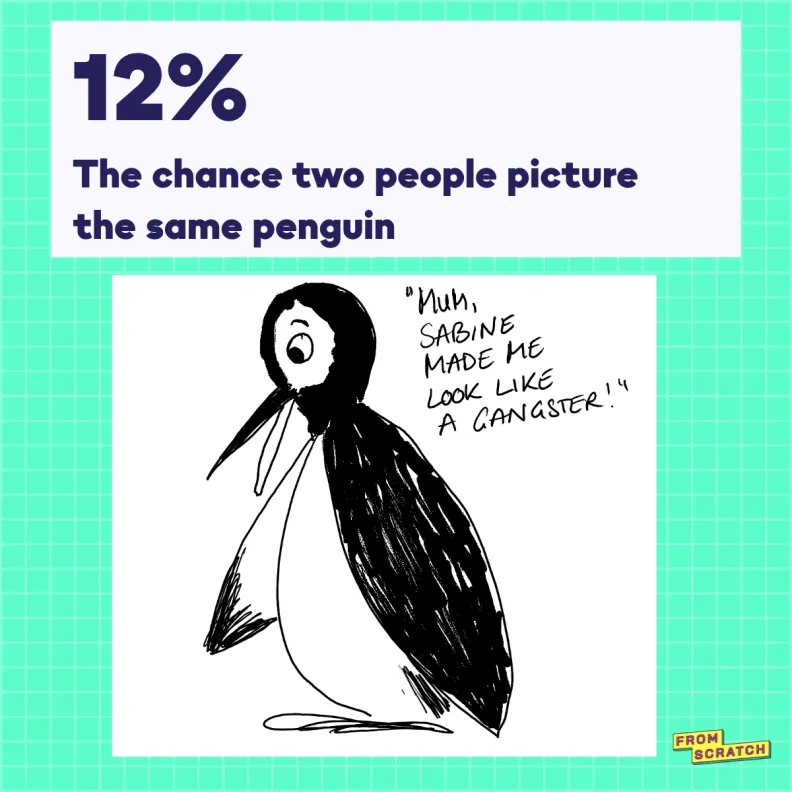
Here’s a penguin chick, hand-drawn by Sabine. The head was the most difficult part, and now the poor bird looks like it’s wearing a balaclava.
Strategic alignment needs shared understanding
Colleagues who work together every day do not necessarily think of that collaboration the same way. So, even if everyone rates collaboration highly, there may still be a gap in understanding each other. And that gap is difficult to see.
You cannot feel whether a colleague holds the same concepts as you, because you only ever see your own. So we tend to overestimate the extent that others share our views. Psychologists have a name for this assumption: the false consensus effect. Pleasant vibes can make it worse. When nobody argues, everybody assumes agreement.
In their 2023 HBR article Is Your Company as Strategically Aligned as You Think It Is?, Vikas Mittal et al. show what that assumption costs: people end up working towards “divergent or even clashing goals” – which hurts progress. Across 500+ employees in 12 organisations, actual alignment averaged 23%, 2–3 times lower than perceived. At one recruiting firm, managers believed alignment was 90%, but it was only 30%. Bigger gaps went hand in hand with slower, lower-quality implementation.
And because everyone uses the same words, this misalignment is difficult to notice from the inside.
A team can work well together and still hold incompatible pictures of what the organisation is, what it needs and what it offers. Individual self-assessment will usually not catch this gap. You need to compare the self-assessments to catch it.
The gap on the inside shows up on the outside
We work to a simple principle: what isn’t clear internally can never be clear externally.
In our workshop, the areas that participants wanted to address first were external-facing: making their offer clear. Capturing the Voice of the Public.
They all depend on an inward agreement that, judging by the maps, was not fully developed.
If 3 colleagues name 3 different strengths, which one goes on the homepage? If they disagree about priorities, whose version goes into the brief? The website ranked lower because it sits downstream of all this. A new website may look more polished, but it does not have the power to transform an unclear offer. That clarity must come from strategic alignment inside your organisation.
The marketing problems people feel most acutely are often a gap in shared understanding, showing up where you and your audience can see it.
Compare the maps before you merge them
The usual response to misalignment is a session that produces one agreed version: a strategy offsite, a values exercise, a new positioning statement. These kinds of initiatives tend to go wrong because they produce groupthink, and they’re not designed to capture the wisdom of the entire organisation. The most senior or most confident voice speaks first and sets the tone. There’s a big risk that everyone else adjusts, prioritising saving face and showing up as rational, productive corporate citizens.
So, we like to turn that logic upside down.
Our mantra is “think with your hands” – whether we use LEGO® SERIOUS PLAY® (where that mantra originated) or pen and paper.
Drawing, building and storytelling elicit tacit knowledge participants cannot fully verbalise yet – cue Polanyi’s paradox: “We can know more than we can tell.” And there’s space for everyone to express their ideas silently and separately, before they’re discussed in the group. This is the logic behind the nominal group technique, developed by Andre Delbecq and colleagues in the early 1970s.
Gaps in shared understanding are the most useful insights we document with these methods. Working towards alignment is not a one-off checklist item, but a transformative experience that will benefit team collaboration, strategic goals and marketing communication alike.
Start with your own map
10 people, 11 answers. That may sound like a complaint, but we think it’s the starting point for most teams.
If you want to see where your organisation’s maps diverge, book a Diagnostic chat with us. It’s free, it takes 45 minutes and all you need is pen and paper. Better still, bring a colleague. Two maps tell you more than one.
And if you’d like to join our next workshop, follow our event calendar on Luma to get notified next time we run Credible by Design.
