
Written by:

Edited by:

Holger Schueler
Table of Contents
Over the course of 2025, a hunch shared by many language geeks hardened into evidence: humans are starting to sound like large language models (LLMs). In the pre-print Empirical evidence of Large Language Model’s influence on human spoken communication, Yakura et al. found AI-favoured words increasing in 740,000 hours of talks and podcasts. The peer-reviewed Model Misalignment and Language Change by Anderson et al. found the same pattern in unscripted conversation: the AI-associated words increased while their unmarked synonyms stayed flat.
We’re all starting to sound like ChatGPT and Claude had a baby
We trained the machines on our language. The machines introduced their own preferences. And because we read so much AI generated text, that preference for “delve”, “meticulous” and “strategically” is now shaping the way we write and talk. As a result, we all sound increasingly the same. Our personal quirks, regional differences, sociolinguistic markers that express our class, ethnicity, age or educational background, and even rare varieties of certain languages: they’re all fading like a flower, to quote a favourite Roxette song.
This may seem like a small thing. But language and culture are inseparable. Our word and grammar choices influence the way we relate to each other. They also shape what we pay attention to, and how we judge what we take in:
Can we even perceive the poetic nature of the autumn morning mist if art does not teach us to recognise its beauty?
Ever since Plato’s day, people have debated whether Art imitates Life or Life imitates Art – a question famously inverted by Oscar Wilde in his 1889 essay, ‘The Decay of Lying’.
Now it’s becoming clear that Life increasingly imitates AI. Claude, ChatGPT and all sorts of CoPilots mirror the averaged-out, US American professional image of what it means to be human back at us. And in that process, they set a standard that moulds us in their image.
Or, as William Davies said in his article What Is LinkedIn?: “machines model the levels of mindfulness and empathy that humans are expected to match.”
How ChatGPT is “quietly” changing the cultures of Cologne, Cairo, Cape Town … and your company
To understand the image that’s forming us, we need to start with how these models learn language. That process is nothing like the language acquisition process in humans. As children, we learn by trying things out, copying the grown-ups around us and getting corrected.
Importantly, we exist outside language – while LLMs are all words, no life. We have world knowledge, sensory input, an inner life. Our thoughts or feelings exist separately from the words we use. An LLM knows nothing about the world: it’s trained to detect the statistical likelihood that “this word” tends to follow “that word”, and then tuned further to produce what people approve of. It can only predict those probabilities because it has ingested huge amounts of text.
Lopsided in, lopsided out
Unfortunately, the training material is not a true representation of humanity.
Much of it comes from Common Crawl, “a nonprofit 501(c)(3) organisation that crawls the web and freely provides its archives and datasets to the public. […] Crawls are published approximately once a month, each typically containing more than two billion web pages”. In other words, this small non-profit has been downloading a copy of the public internet every month since 2008 and giving it away for free. As of this article, roughly 40% of that data is in English – which makes sense, because English is still the dominant language online. As of 2026, Russian is the second most frequent language at almost 7%, followed by German (around 6%), Japanese (just over 5%) and French (just under 5%).
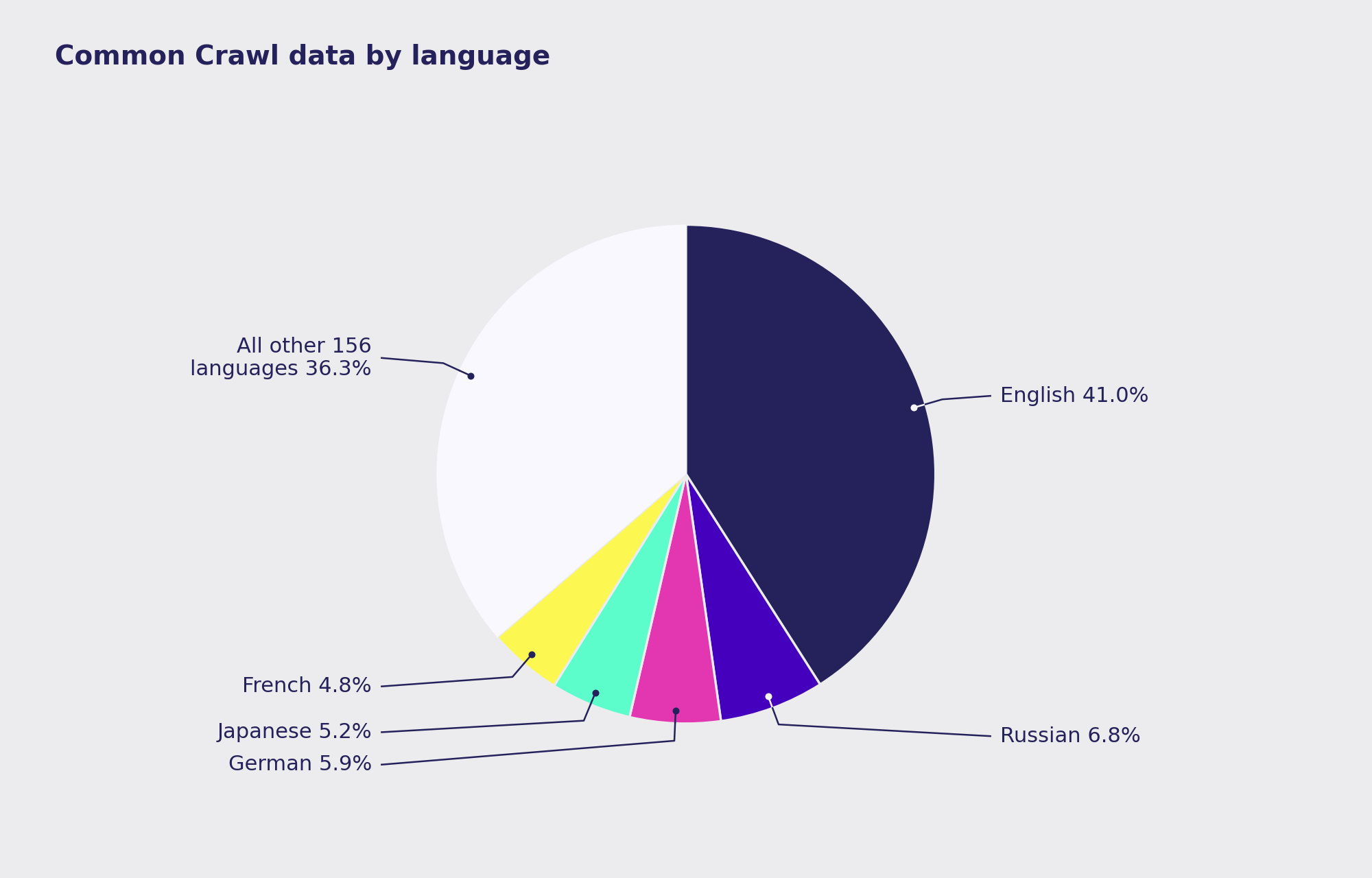
But compare this data to the languages people speak as a first language – and you’ll see that Common Crawl is not an accurate representation of humanity. (Ranks shown as they fall in the full list: the languages that dominate Common Crawl sit at 8, 9, 16 and 17 by native speakers.)
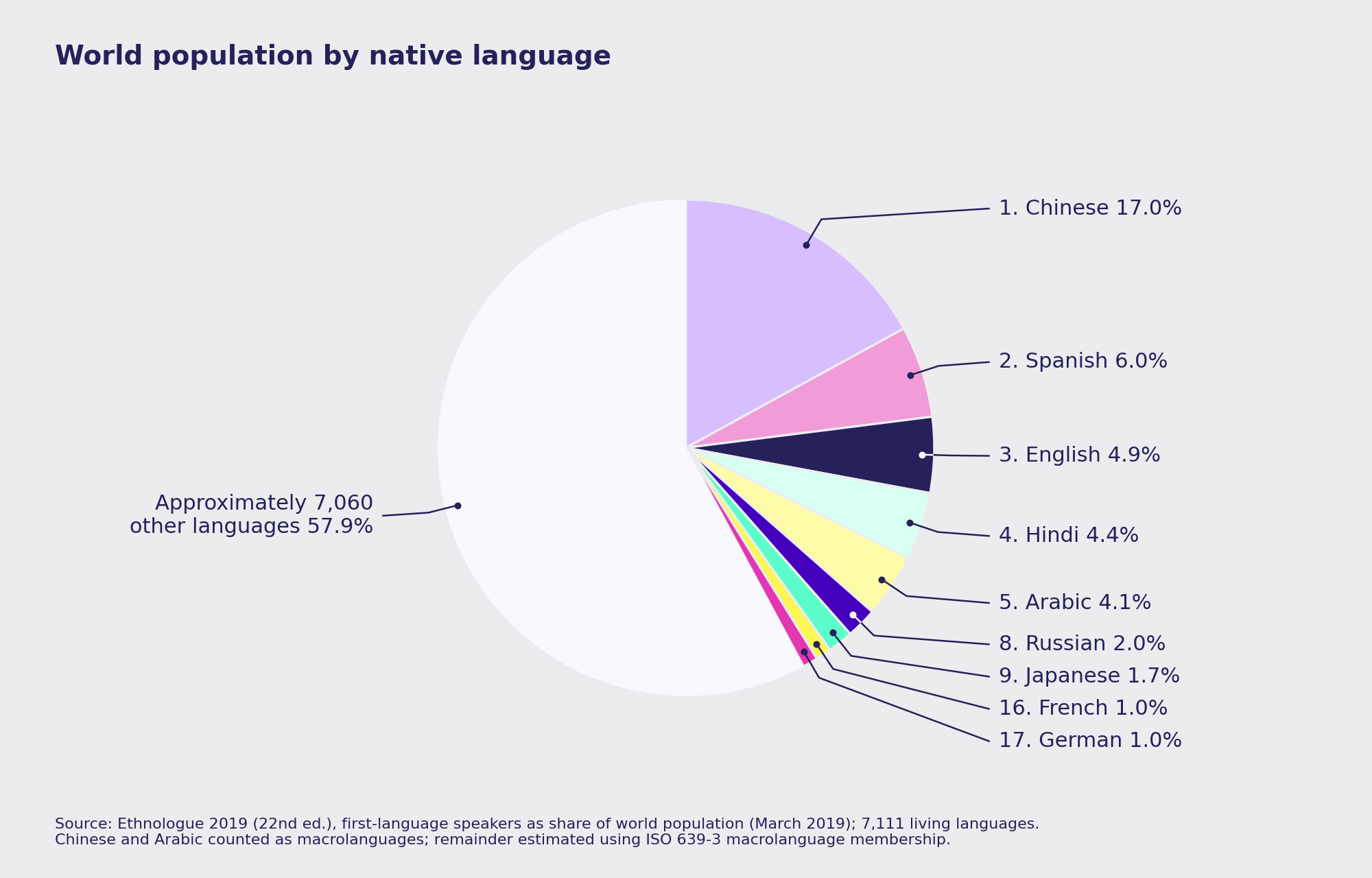
Source: Ethnologue 2019(22nd ed.), first-language speakers as share of world population (March 2019): 7,111 living languages. Chinese and Arabic counted as macrolanguages; remainder estimated using ISO 639-3 macrolanguage membership.
According to a 2024 study by the Mozilla Foundation, Common Crawl is a significant ingredient in LLM training data. So, if you speak English, Russian, German, Japanese or French, you’re lucky: LLMs will perform better in your language. But the gap between English and the rest is still enormous, and it influences what AI chats produce.
The Ghost in the Machine has an American Accent
Researchers have been able to show just how strongly anglophone cultures have influenced what ChatGPT produces. The same is probably true of Claude and other LLM products, though there appears to be less data available.
A 2022 (pre-print) paper by Johnson et al. with the title The Ghost in the Machine has an American Accent: value conflict in GPT-3 concludes that “many altered values in the outputs are aligned with the dominant voice baked into the training data.”
In the peer-reviewed 2024 paper Cultural Bias and Cultural Alignment of Large Language Models, Tao et al. benchmarked various GPT models against World Values Survey data across 107 countries and found that “[a]ll models exhibit cultural values resembling English-speaking and Protestant European countries.”
Which Humans? by Atari et al., a similar (pre-print) paper from 2023, had found GPT sitting closest to the United States.
The winners write history; the ones that write, win
In Frank Herbert’s science fiction novel God Emperor of Dune, people turn to the Oral History alongside the Official History to understand the past: songs, stories, fairy tales and legends. Likewise, in many of our societies today, this kind of history has never been written down. This is especially true of many African and Asian cultures and languages.
If you want an LLM to be truly multilingual and multicultural, you need text that exists in translation. Ideally, you want the same content in two languages, with obvious indicators of which phrases correspond to each other. That way, the system can learn that one phrase means another.
The religious conquest of LLM input
For many languages, the only kind of text that exists in this form is religious: the Bible and magazines published by the Jehovah’s Witnesses. Conveniently for LLM training, the Bible comes with its own addressing system. John 3:16 in the King James Bible is John 3:16 in almost every other Bible, in almost every language. The chapter divisions date to Stephen Langton in Paris around 1227. The verse numbers came from a printer, Robert Estienne, who added them to his Greek New Testament in 1551 (as the story goes, he was numbering verses on horseback, on the journey between Paris and Lyon).
These references were meant to help preachers and scholars find a passage. They turned out to be exactly the data structure machine translation needs.
So, Christian missionary literature forms the basis of machine translation for languages with millions of speakers, introducing words and ideas that are not native to those cultures in any way. The Oral Histories of these cultures did not make it into the models because they were not available in writing in a structured way.
Informal, unwritten rules are the first to go
If your brand values only live in people’s heads, you’ll never be able to get good outputs from LLMs. Plenty of organisations rely on a senior person who says “I’ll know it when I see it” and gives the thumbs up or down on anything from advertising campaigns to internal events. Sure, this approach works, in a way … until you start delegating tasks to the machine.
We tested this on ourselves last year, asking an AI writing tool to create LinkedIn posts based on our existing blog articles. The tool had access to our style guide, but we had not trained it on our Intention Stack: our Vision, Mission, Objectives, Values and Principles. What came back read shouty, hyper-capitalist and flat. Someone reading those posts must have worried we might have been hacked and impersonated by strangers.
Is Shadow AI changing your culture?
Whether or not you “officially” introduced AI tools at work, people will use them anyway. In our clients’ organisations we regularly see strict guidelines on data handling and tool use, and then a report turns up with links clearly marked as copy/pasted from an unapproved model. Which prompt was used to produce the report? Which data was fed into the “Shadow AI”? Nobody knows, and this poses a big risk for organisations.
Not just because of data leaking into unapproved software, but also because the LLM will infuse your communication with its own values. If you do not point each prompt to a written account of how you sound and what matters to your organisation, the AI will produce output in line with its built-in biases. The direction of travel is the same for all LLM users who do not take precautions, which means everyone’s starting to sound the same. An organisation in Scotland, Bavaria or Iceland loses its unique character. The specificity that made you interesting, emotive and memorable is eroded.
Sounds convincing, says nothing
The biggest problem here is that you might not even notice it happening.
AI generated content is seductively fluent. These tools are remarkably good at producing vapid text that reads as clever: it has rhythm, it has confidence, and it’s utter rubbish. That’s exactly what you’d expect from a system tuned to produce what people approve of, rather than what is true.
Marketing teams have spent decades fighting the accusation that this is all they do. Now everyone can generate “copy”, and organisations publish a lot of slop because somebody skimmed it and thought it looked “fine”.
Diagnosing fake alignment
One of our mantras is that what isn’t clear internally can never be clear externally. This used to be easy to demonstrate: A website with broken customer journeys, the tone shifting from “down with the kids” to bureaucratic between pages, different descriptions of the same service – those symptoms were obvious.
In contrast, AI generated copy is fluent by default. It will impose a level of order when you prompt it for your website. That looks convincing from the outside, until people start to engage with you for real: buying a product, signing up for regular donations, applying for a job, asking you a question. As long as your teams operate in silos and you haven’t turned your values into infrastructure, your website will raise expectations that you cannot meet. In an ideal world, your website serves as a single source of truth – but that alignment is the result of humans working together. It cannot be AI generated. AI simply covers it up, like a mouldy patch behind fresh paint.
Your organisation has an Oral History too
Remember the Oral Histories that never made it into the models? Your organisation has its own version of that: informal agreements that nobody wrote down, the reason certain decisions went the way they did, the taste and judgement new joiners absorb as they work alongside senior management. It’s probably your most valuable brand asset, and the least documented.
We run a queer-owned business, which changes what we notice. Without being told our values first, these systems hand us output that is heteronormative, relentlessly commercial and casually ableist or ageist. That’s why our Intention Stack is a crucial part of the context for any AI supported work for our brand. Many organisations have nothing comparable set up, because there is no up-to-date version of those values in written form – beyond a motivational poster, perhaps.
Culture as infrastructure
This is what we mean when we talk about your culture as infrastructure rather than the slogan on your lanyards or a series of events. Documenting your culture earns its keep twice over: you build agreement and alignment across teams, and this coherence makes you stronger. As a bonus, you have vetted context to hand the machine.
Wilde thought life imitates art. Life now imitates AI – and AI imitates whoever bothered to write things down. So the question facing your organisation is not whether you will use these tools, because you already do. Does the AI generated version of you come close to your IRL?
Get your Diagnostic
If you’d like to find out where your organisation currently stands, book a Diagnostic chat with us. It’s free, it takes 45 minutes, and all you need to bring is pen and paper. We’ll walk you through our diagnostic model, where you map your organisation across 9 areas: what’s working well, what needs treatment, and whether this is something you can tackle yourselves or would rather not do alone.
P.S. We talked about all of this with Janina Neumann on The Bicultural Podcast, too. Check out the episode:
